
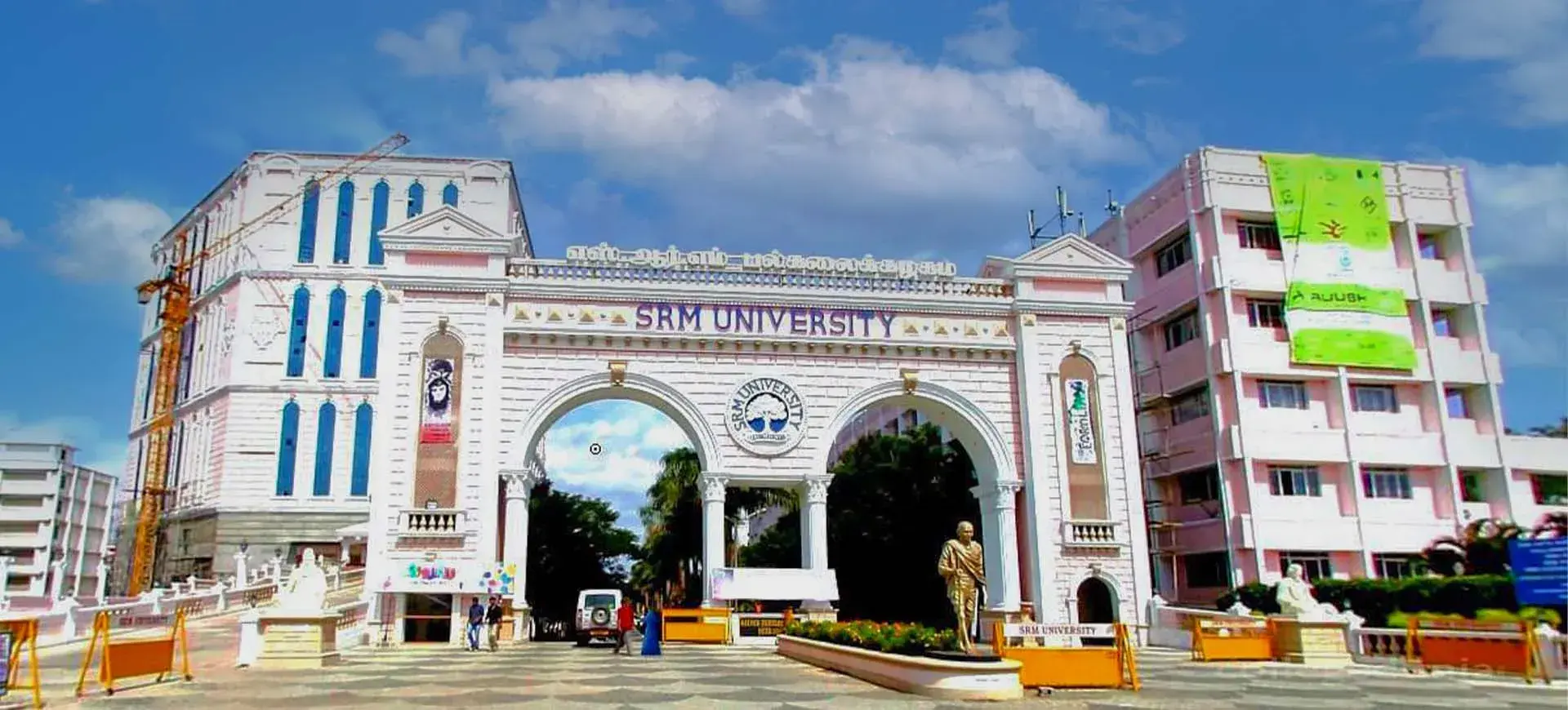
SRM University - Chennai
A comprehensive multi-disciplinary university offering programs in Engineering, Management, Health Sciences, Pharmacy, Law, Architecture, Science & Humanities, and more
About
SRM University - Chennai is one of India’s leading private deemed-to-be universities, located at Kattankulathur near Chennai, Tamil Nadu. Known for its modern campus, research-driven environment, and strong industry connect, SRM offers a wide range of programs across Engineering & Technology, Management, Medicine & Health Sciences, Science & Humanities, Law, and more.
The university attracts students from across India and abroad, thanks to its contemporary curriculum, global collaborations, experienced faculty, and excellent placement record. With multiple campuses and a vibrant residential setup, SRM provides a comprehensive learning ecosystem that combines academics, innovation, and campus life.
College Highlights
College Highlights
Key Accreditations & Recognitions
Key Accreditations & Recognitions
NAAC A++ Accreditation
SRM Institute of Science and Technology is accredited with the highest NAAC grade (A++), reflecting strong teaching, research, and infrastructure quality.
Regulatory Approvals
Programs are approved/recognized by relevant statutory bodies such as UGC, AICTE, NMC, PCI and other councils, depending on the discipline.
National Rankings
SRM regularly features in national rankings (like NIRF) for engineering and other disciplines, and maintains strong industry connections for internships and placements.
Faculties & Programs
Faculties & Programs
Programs Offered
SRM University offers a comprehensive range of undergraduate, postgraduate, and doctoral programs across multiple disciplines. Below are some of the key programs available across different faculties:
Engineering & Technology
B.Tech Programs
Duration: 4 years (8 semesters)
Key Specializations: Computer Science & Engineering (CSE), Electronics & Communication Engineering (ECE), Mechanical Engineering, Civil Engineering, Electrical Engineering, Aerospace Engineering, Biotechnology, Biomedical Engineering, Artificial Intelligence, Data Science, Cyber Security, Cloud Computing, IoT, and many more.
Eligibility: 10+2 or equivalent with Physics, Chemistry, Mathematics; minimum aggregate as per SRM norms; selection through SRMJEEE or valid national-level entrance scores.
M.Tech Programs
Duration: 2 years (4 semesters)
Key Specializations: Computer Science & Engineering, Full Stack Development, VLSI Design, Power Systems, Structural Engineering, and various other engineering specializations.
Eligibility: B.Tech/B.E. in relevant discipline with minimum aggregate; GATE score preferred or as per university norms.
Management
BBA (Bachelor of Business Administration)
Duration: 3 years (6 semesters)
Key Areas: Business Management, Marketing, Finance, Human Resources, International Business, Entrepreneurship.
Eligibility: 10+2 in any stream with required aggregate; selection through SRMJEEM or merit-based.
MBA (Master of Business Administration)
Duration: 2 years (4 semesters)
Key Specializations: Marketing, Finance, Human Resources, Operations, Business Analytics, International Business, Healthcare Management, and more.
Eligibility: Recognized bachelor's degree with minimum aggregate; performance in SRMJEEM, CAT, MAT, XAT, CMAT, or other national-level management entrance tests.
Health Sciences & Medicine
MBBS (Bachelor of Medicine, Bachelor of Surgery)
Duration: 5.5 years (including 1 year internship)
Eligibility: 10+2 with Physics, Chemistry, Biology; minimum aggregate as per NMC norms; NEET qualification mandatory.
M.S / M.D / M.Ch / D.M Programs
Duration: 3-5 years depending on specialization
Specializations: General Surgery, Obstetrics & Gynaecology, Orthopaedics, Ophthalmology, ENT, Emergency Medicine, Cardiology, Neurology, and various super-specialty programs.
Eligibility: MBBS/MD degree with required qualifications; NEET-PG/NEET-SS as applicable.
M.Sc in Health Sciences
Duration: 2 years
Specializations: Medical Laboratory Technology, Medical Imaging Technology, Critical Care Technology, Clinical Psychology, Audiology, Speech Language Pathology, and various allied health programs.
Eligibility: Relevant bachelor's degree in health sciences or related field with minimum aggregate.
Pharmacy
B.Pharm (Bachelor of Pharmacy)
Duration: 4 years
Eligibility: 10+2 with Physics, Chemistry, Biology/Mathematics; minimum aggregate as per PCI norms.
M.Pharm (Master of Pharmacy)
Duration: 2 years
Specializations: Pharmaceutics, Pharmacology, Pharmaceutical Chemistry, Pharmacognosy, Pharmacy Practice, Pharmaceutical Quality Assurance, Pharmaceutical Regulatory Affairs.
Eligibility: B.Pharm degree with minimum aggregate; GPAT score preferred.
Pharm.D (Doctor of Pharmacy)
Duration: 6 years (including internship)
Eligibility: 10+2 with Physics, Chemistry, Biology/Mathematics; or B.Pharm for Pharm.D (Post Baccalaureate).
Architecture & Design
B.Arch (Bachelor of Architecture)
Duration: 5 years
Eligibility: 10+2 with Mathematics as compulsory subject; minimum aggregate; NATA or JEE (Main) Paper 2 score required.
B.Des (Bachelor of Design) - Interior Design
Duration: 4 years
Eligibility: 10+2 in any stream with required aggregate; design aptitude test may be required.
Science & Humanities
B.Sc / M.Sc Programs
Duration: B.Sc – 3 years; M.Sc – 2 years
Key Areas: Physics, Chemistry, Mathematics, Biotechnology, Microbiology, Computer Science, Psychology, Economics, English, and various other disciplines.
Eligibility: 10+2 for B.Sc; relevant bachelor's degree for M.Sc with minimum aggregate.
Law
B.A. LL.B / BBA LL.B / LL.B
Duration: 5 years (integrated) or 3 years (LL.B)
Eligibility: 10+2 for integrated programs; bachelor's degree for LL.B; CLAT or university entrance test score.
LL.M (Master of Laws)
Duration: 1-2 years
Eligibility: LL.B degree with minimum aggregate; entrance test as per university norms.
Other Programs
Additional Programs
SRM University also offers programs in Agriculture, Veterinary Sciences, Hotel Management & Catering, Mass Communication, Physical Education, and various Certificate & Diploma programs in specialized fields.
Note: Program availability, specializations, and eligibility criteria may vary by campus. Please check the official SRM University website or contact admissions for the most current information.
Why Choose SRM University?
- Comprehensive range of programs across Engineering, Management, Health Sciences, Pharmacy, Law, Architecture, and more.
- Modern infrastructure with state-of-the-art labs, libraries, research centres, and industry-collaboration facilities.
- Strong placement support with dedicated placement cells and extensive recruiter network across diverse industries.
- Experienced faculty, research opportunities, and global collaborations for enhanced learning.
- Vibrant campus life with active student clubs, cultural fests, sports facilities, and holistic development programs.
Fee Structure
View Complete Fee Structure 2026-2027SRM University offers multiple programs and campuses, and the exact fee structure can vary by course, specialisation, and year of admission. Below is an indicative view of how the fee components are typically structured – please treat this as a guide and always confirm the latest figures from your Yuwah Counsellor.
📋 For the complete, detailed fee structure for all programs at SRM KTR Campus (2026-2027), please click here.
Important: Please contact your Yuwah Counsellor for the latest fee structure and details.
Want help understanding the latest fees, scholarships and payment plans?
Frequently Asked Questions
Admissions
What are the eligibility criteria for different programs at SRM University?
Eligibility varies by program: B.Tech requires 10+2 with Physics, Chemistry, and Mathematics; MBBS requires 10+2 with Physics, Chemistry, Biology and NEET qualification; BBA requires 10+2 in any stream; MBA requires a recognized bachelor's degree; B.Pharm requires 10+2 with Physics, Chemistry, Biology/Mathematics; B.Arch requires 10+2 with Mathematics and NATA/JEE (Main) Paper 2; Law programs require 10+2 or bachelor's degree with CLAT scores. Always check the latest SRM admission brochure for specific requirements.
Which entrance exams are accepted for different programs?
SRM accepts various entrance exams depending on the program: Engineering – SRMJEEE or national-level tests; Management – SRMJEEM, CAT, MAT, XAT, CMAT; Medicine – NEET (mandatory for MBBS); Architecture – NATA or JEE (Main) Paper 2; Law – CLAT or university entrance test; Pharmacy – University entrance or merit-based. Some programs may also consider national-level entrance scores. Check the latest admission policy for current requirements.
How can I apply for admission to SRM University?
You can apply for admission to SRM University by contacting your Yuwah Counsellor.
Academic Information
What is the medium of instruction at SRM University?
The medium of instruction for all programs at SRM University is English, ensuring that students from across India and abroad can comfortably follow the curriculum.
What are the typical program durations at SRM?
Program durations vary: B.Tech – 4 years; BBA – 3 years; MBA – 2 years; MBBS – 5.5 years (including internship); B.Pharm – 4 years; Pharm.D – 6 years; B.Arch – 5 years; M.Tech – 2 years; M.Pharm – 2 years; M.S/M.D/M.Ch/D.M – 3-5 years depending on specialization; Law programs – 3-5 years. Always refer to the latest SRM prospectus for exact durations.
Does SRM offer internships, clinical training, and industry projects?
Yes, SRM has active industry partnerships and provides various practical learning opportunities: Engineering & Management students get internships and live projects with industry partners; Medical & Health Sciences students receive clinical training at SRM hospitals and affiliated healthcare facilities; Pharmacy students have industrial training and hospital pharmacy exposure; Law students participate in moot courts and internships with law firms. These experiences help students gain real-world exposure and enhance employability.
Fees & Scholarships
How can I know the exact fee for a particular program?
The exact fee varies by campus, program, and specialisation. SRM publishes the latest fee structure on its official website and in the admission brochure each year – those documents should be treated as final.
Are scholarships available?
SRM typically offers a range of merit-based and other category scholarships, subject to eligibility and availability. Details are provided in official notifications for each admission cycle.
Why should I consider SRM over other private universities?
SRM combines a large, modern campus, NAAC A++ accreditation, multiple specialisations, active research, and strong placement records. Students also benefit from exposure to industry projects, clubs, fests and a diverse peer group.
Campus Life
What kind of hostel facilities are available?
SRM offers on-campus hostels with options for different room types. Facilities generally include Wi‑Fi, mess, laundry and recreational spaces; details can differ by campus and block.
How is the safety and security on campus?
Campuses are generally monitored by security personnel and CCTV, and there are defined policies to support student safety and discipline.